AI Agents vs Automation: Key Differences and When to Use Each in 2026
Understanding the key differences between AI agents and traditional automation in 2026. Learn when to use each, their strengths, limitations, and how to combine them for maximum business impact.
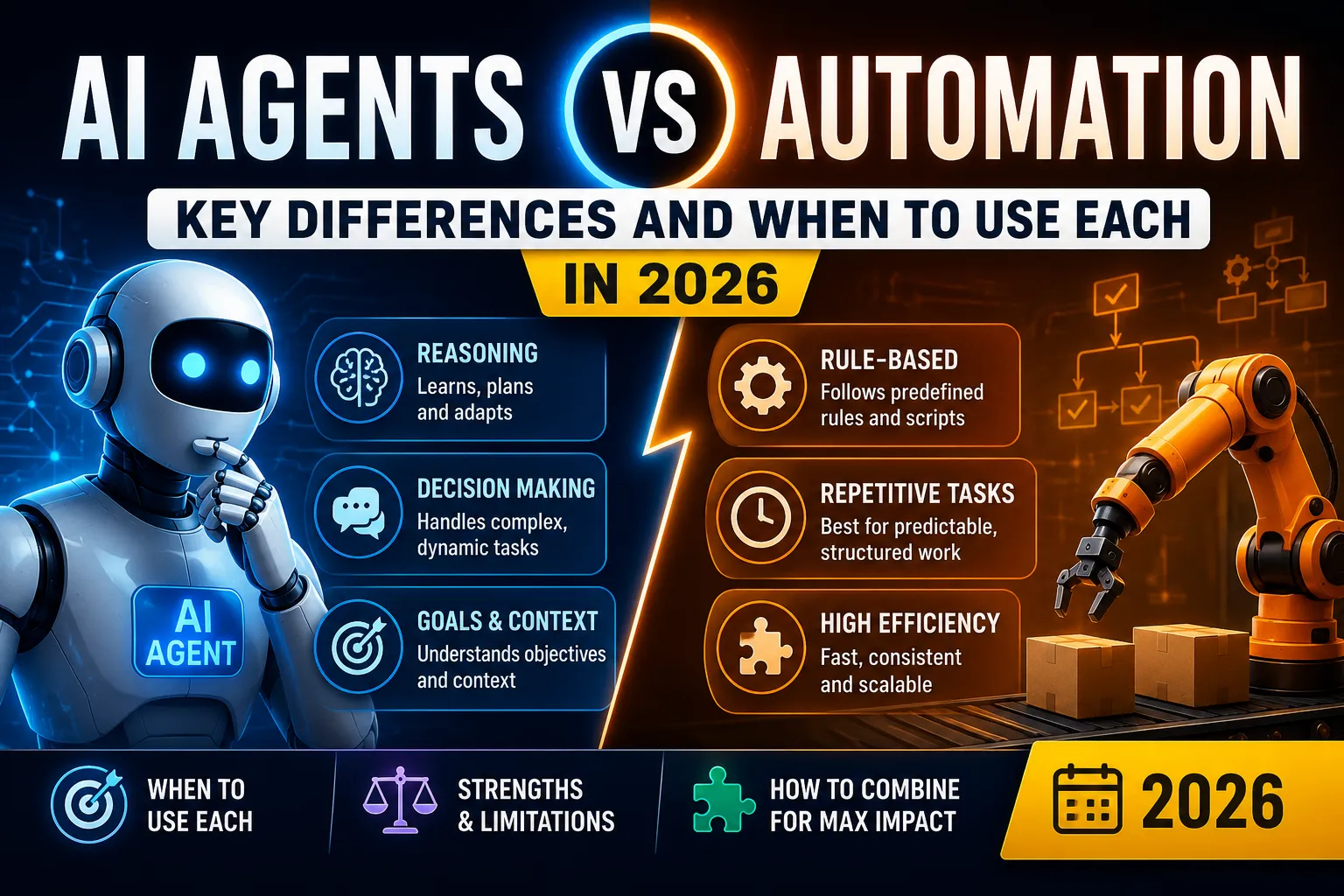
AI Agents vs Automation: Key Differences and When to Use Each in 2026
Two powerful technologies are transforming business operations: AI agents and automation.
While they overlap, they serve different purposes. Understanding when to use each is critical for maximizing efficiency and ROI.
This guide explains the key differences between AI agents and automation, with practical guidance on when to use each.
Key Takeaways
- AI agents are autonomous decision-makers that can plan, adapt, and execute complex tasks.
- Traditional automation follows fixed rules and executes predefined actions.
- AI agents are flexible and can handle unstructured situations.
- Automation is predictable and reliable for repetitive tasks.
- The best approach combines both – automation for predictable tasks, AI agents for complex decision-making.
- AI agents are not replacing automation – they're complementing it.
Who Is This Guide For?
This guide is for:
- Business owners and founders
- Operations managers
- IT leaders and developers
- Anyone evaluating AI agent platforms
What Are AI Agents?
AI agents are autonomous systems that can:
- Plan – Define a sequence of actions to achieve a goal
- Make decisions – Choose between options based on context
- Execute – Take actions independently
- Learn – Improve from feedback
- Adapt – Adjust to new situations
Think of an AI agent as: A digital employee that can be given a goal and work independently to achieve it.
Key Characteristics
What Is Traditional Automation?
Traditional automation follows rules and executes predefined actions.
Think of traditional automation as: A machine that performs the same action every time it receives a specific trigger.
Key Characteristics
Key Differences: Side-by-Side Comparison
When to Use Traditional Automation
Best Use Cases
-
Data Transfer
- Moving data between systems
- Formatting and mapping data
-
Notifications
- Sending emails, SMS, Slack messages
- Scheduled alerts
-
Scheduled Tasks
- Report generation
- Data backups
-
Simple Routing
- Assigning tickets to agents
- Routing leads
-
Filing and Organizing
- Sorting documents
- Archiving records
Example: Lead Data Sync
Task: When a new lead fills out a form, add them to the CRM and send a welcome email.
Automation approach:
- New lead form submission triggers workflow
- System adds lead to CRM
- System sends welcome email
Why automation works:
- The task follows clear rules
- Every lead gets the same treatment
- No decision-making is required
When to Use AI Agents
Best Use Cases
-
Customer Support
- Handling full conversations
- Understanding and resolving issues
-
Sales
- Qualifying leads with complex criteria
- Managing follow-up sequences
-
Research
- Gathering and analyzing data
- Summarizing information
-
Operations
- Managing supply chains
- Optimizing processes
-
Decision-Making
- Complex approvals
- Strategic choices
Example: Sales Lead Qualification
Task: When a new lead arrives, qualify them, determine if they're a good fit, and initiate appropriate follow-up.
AI agent approach:
- AI agent receives new lead
- Agent researches lead (company, industry, decision-makers)
- Agent scores lead based on multiple criteria
- Agent determines next steps (sales call, nurture, drop)
- Agent executes next steps
- Agent learns from outcomes
Why AI agents work:
- The task requires decision-making
- Criteria are complex and contextual
- Adaptation is needed
- Learning improves results
Combining AI Agents and Automation
The most powerful approach combines both.
Hybrid Architecture
- Automation handles the predictable: Data transfer, notifications, routing
- AI agents handle the complex: Decision-making, planning, adaptation
Example: Customer Support
Automation part:
- Receives the ticket (trigger)
- Logs the ticket in the system
- Notifies the customer of receipt
- Gathers available context (customer data, history)
AI agent part:
- Analyzes the ticket content
- Determines the best response
- Drafts a personalized reply
- Escalates if needed
- Learns from the interaction
Example: Lead Management
Automation part:
- Receives the lead form submission
- Adds lead to CRM
- Sends acknowledgment email
AI agent part:
- Researches the lead (company, industry, decision-makers)
- Scores the lead (fit and intent)
- Determines next steps (sales, nurture, drop)
- Executes the next steps
- Learns from outcomes
Tools for AI Agents
AI Agent Platforms
Choosing the Right Tool
Implementation Considerations
Traditional Automation
Ease: High (low learning curve)
Time to implement: Days to weeks
Data requirements: Low
Cost: Lower (tools $0-800/month)
Skills needed: Basic tech literacy
Risk: Low (predictable outcomes)
AI Agents
Ease: Medium to high (steeper learning curve)
Time to implement: Weeks to months
Data requirements: High (quality data needed)
Cost: Higher (tools $50-1,000+/month + API costs)
Skills needed: Technical expertise
Risk: Medium (AI can make mistakes)
Common Mistakes
Mistake 1: Using AI Agents Where Automation Works
Don't: Use AI agents for simple, repetitive tasks.
Do: Use automation for predictable tasks.
Mistake 2: Using Automation Where AI Agents Are Needed
Don't: Try to solve complex problems with fixed rules.
Do: Use AI agents for decision-making, adaptation, and planning.
Mistake 3: Not Combining Both
Don't: Choose one approach for everything.
Do: Combine automation and AI agents where they complement each other.
Mistake 4: Overestimating AI Capabilities
Don't: Expect AI agents to be perfect.
Do: Plan for errors and include human review.
Mistake 5: Underestimating Implementation Complexity
Don't: Assume AI agents are easy to implement.
Do: Plan for data preparation, testing, and iteration.
Real-World Examples
Example 1: Customer Support
Automation:
- Receives ticket
- Logs ticket
- Sends acknowledgment
AI Agent:
- Analyzes ticket
- Determines response
- Drafts reply
- Escalates if needed
Result: 80% faster response, 60% fewer escalations
Example 2: Lead Management
Automation:
- Receives lead
- Adds to CRM
- Sends acknowledgment
AI Agent:
- Researches lead
- Scores lead
- Determines next steps
- Executes follow-up
Result: 50% more conversions, 80% time saved
Example 3: Supply Chain Management
Automation:
- Monitors inventory levels
- Generates reorder alerts
- Updates records
AI Agent:
- Predicts demand
- Makes reorder decisions
- Manages supplier relationships
- Optimizes inventory
Result: 30% lower inventory costs, 20% fewer stockouts
Future Trends (2026-2027)
Trend 1: Agentic Automation
AI agents will become more autonomous, handling entire business processes with minimal human intervention.
Trend 2: Multi-Agent Collaboration
Teams of specialized AI agents working together on complex tasks.
Trend 3: Human-AI Collaboration
Better integration between AI agents and human workers, with clear handoffs.
Trend 4: Agentic Workflow Builders
No-code tools that allow anyone to build AI agents and workflows.
Trend 5: Agentic Automation Platforms
Platforms that combine traditional automation, AI agents, and human oversight.
Conclusion
AI agents and automation serve different purposes. Neither is better than the other – they complement each other.
Summary:
- Automation: Predictable, rule-based, reliable. Use for repetitive tasks.
- AI agents: Autonomous, adaptive, learning. Use for complex decision-making.
- Hybrid approach: The best of both worlds. Use both where they fit.
Your next steps:
- Audit your workflows
- Identify which tasks fit automation vs AI agents
- Start with automation for simple tasks
- Add AI agents for complex decisions
- Combine both for maximum impact
FAQ
What is the difference between AI agents and automation?
AI agents are autonomous systems that can make decisions, plan, and execute complex tasks with minimal human input. Traditional automation follows fixed rules and executes predefined actions. AI agents are more flexible and can adapt to new situations, while automation is predictable and reliable.
When should I use AI agents vs automation?
Use traditional automation for repetitive, predictable tasks with clear rules. Use AI agents for complex, multi-step tasks that require decision-making, planning, and adaptation. The best approach often combines both.
Are AI agents replacing traditional automation?
No. AI agents are complementing and extending traditional automation, not replacing it. Traditional automation handles the predictable, repetitive tasks while AI agents handle complex decision-making and adaptation. Many businesses use both together.
What are examples of AI agents in business?
Examples include AI agents for customer support (handling full conversations), sales agents (qualifying and following up), research agents (gathering and analyzing data), and operations agents (managing supply chains).
Which is easier to implement: AI agents or automation?
Traditional automation is generally easier to implement because it follows clear rules. AI agents require more complex setup, data preparation, and testing. However, no-code platforms are making AI agents increasingly accessible.
Can I combine AI agents and automation?
Yes. The most effective approach combines both. Use automation for predictable, repetitive tasks and AI agents for complex decision-making and adaptation. This hybrid approach gives you the best of both worlds.
Related Guides
- AI Automation Guide for Businesses in 2026
- How to Automate Business Workflows with AI
- How to Build AI Workflows: A Step-by-Step Guide
- AI Automation Examples: Real-World Use Cases
Read Next
- Best AI Workflow Builders: A 2026 Comparison
- Common AI Automation Mistakes to Avoid
- AI Automation Trends 2026: What's Coming Next
Related articles
Automation strategies for SaaS Metrics & KPIs
Frequently asked questions
What is the difference between AI agents and automation?
AI agents are autonomous systems that can make decisions, plan, and execute complex tasks with minimal human input. Traditional automation follows fixed rules and executes predefined actions. AI agents are more flexible and can adapt to new situations, while automation is predictable and reliable.
When should I use AI agents vs automation?
Use traditional automation for repetitive, predictable tasks with clear rules. Use AI agents for complex, multi-step tasks that require decision-making, planning, and adaptation. The best approach often combines both.
Are AI agents replacing traditional automation?
No. AI agents are complementing and extending traditional automation, not replacing it. Traditional automation handles the predictable, repetitive tasks while AI agents handle complex decision-making and adaptation. Many businesses use both together.
What are examples of AI agents in business?
Examples include AI agents for customer support (handling full conversations), sales agents (qualifying and following up), research agents (gathering and analyzing data), and operations agents (managing supply chains).
Which is easier to implement: AI agents or automation?
Traditional automation is generally easier to implement because it follows clear rules. AI agents require more complex setup, data preparation, and testing. However, no-code platforms are making AI agents increasingly accessible.

Author
saad-elfallah
Saad writes about AI systems, software engineering, cybersecurity, and the tools shaping modern product teams.


