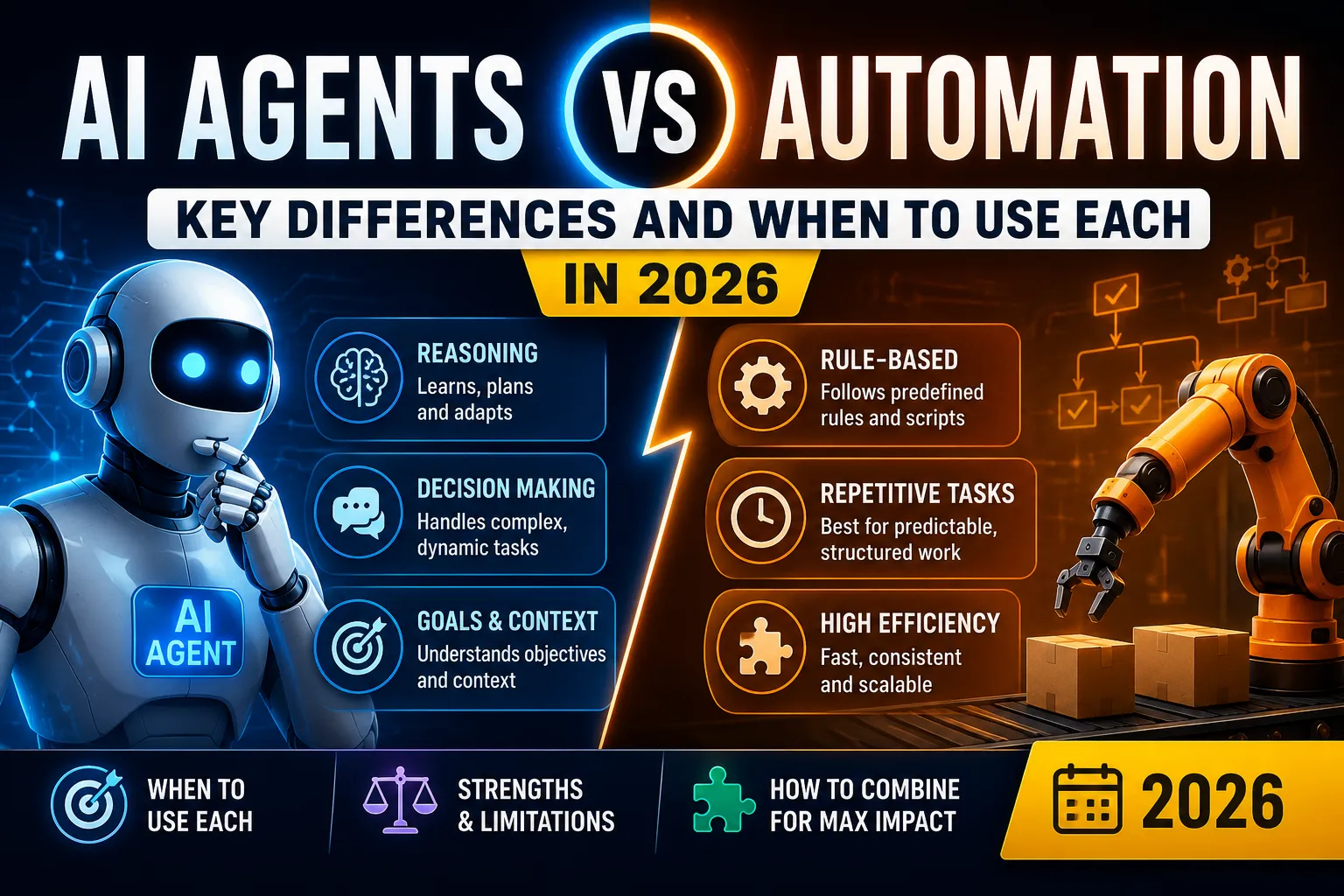
AI Automation Examples: Real-World Use Cases for 2026
Real-world examples of AI automation across industries in 2026. Discover practical use cases in customer support, marketing, sales, HR, finance, operations, and more.

AI Automation Examples: Real-World Use Cases for 2026
AI automation isn't theoretical. It's happening right now in businesses of all sizes.
This guide provides real-world examples of AI automation across industries. Each example shows the problem, solution, results, and ROI.
Key Takeaways
- AI automation works across all industries – from retail to healthcare to finance.
- Customer service automation is the most common use case, delivering 30-60% ticket deflection.
- Marketing and sales automation drive significant revenue growth.
- HR and finance automation deliver massive time savings and cost reductions.
- The best automation examples show clear ROI – often 300-1,000% or more.
Who Is This Guide For?
This guide is for:
- Business owners and founders
- Operations managers
- Anyone considering AI automation
Customer Service Automation Examples
Example 1: E-commerce Chatbot
Industry: E-commerce
Problem: 200+ customer support tickets daily. Most were common questions: shipping status, return policy, product availability.
Solution: AI chatbot trained on the knowledge base. Handled common questions, escalated complex issues to humans.
Implementation:
- Trained AI on 5,000+ past tickets
- Integrated with e-commerce platform and knowledge base
- Deployed chatbot on website and mobile app
- Monitored and improved based on feedback
Results:
- 65% of tickets handled by AI without human intervention
- Response time: 8 hours → 15 minutes
- Customer satisfaction: 82% → 94%
- Support team: 8 agents → 5 agents
- Annual savings: $80,000
Tools used: Intercom AI, Zendesk AI
ROI: 450%
Example 2: Enterprise Ticketing System
Industry: Technology (SaaS)
Problem: 5,000+ tickets per week. Misrouting caused 4-hour delays. Agents overwhelmed.
Solution: AI ticketing system with intelligent routing and response suggestions.
Implementation:
- AI analyzed ticket content (intent, urgency, language)
- AI matched tickets to the right agents
- AI generated response suggestions
- AI escalated based on sentiment
Results:
- Ticket routing time: 4 hours → 2 minutes
- Response time: 6 hours → 30 minutes
- Agent workload: 100 tickets/week → 60 tickets/week
- First contact resolution: 55% → 78%
- Annual savings: $200,000
Tools used: Zendesk AI, Forethought AI
ROI: 600%
Example 3: Financial Services Support Automation
Industry: Financial Services
Problem: 1,000+ inquiries monthly. 70% were basic questions (account balance, transaction history, branch hours).
Solution: AI voice assistant and SMS chatbot.
Implementation:
- AI trained on common questions
- Deployed voice AI for phone inquiries
- Deployed SMS chatbot for text inquiries
- Integrated with banking systems
Results:
- 70% of inquiries handled by AI
- Call center volume: 1,000 calls/month → 300 calls/month
- Wait time: 10 minutes → 30 seconds
- Customer satisfaction: 78% → 91%
- Annual savings: $120,000
Tools used: Ada AI, Ultimate.ai
ROI: 380%
Marketing Automation Examples
Example 4: Content Creation at Scale
Industry: Digital Marketing Agency
Problem: Creating 50 blog posts, 100 social posts, and 20 email newsletters monthly. Content team of 5 was overwhelmed.
Solution: AI-powered content creation and distribution.
Implementation:
- AI generated content drafts
- Human editors refined and approved
- AI distributed content across channels
- AI analyzed performance and optimized
Results:
- Content output: 50 pieces/month → 200 pieces/month (4x increase)
- Time per piece: 4 hours → 30 minutes
- Team: 5 writers → 2 writers + AI
- Engagement: +25% increase
- Annual savings: $60,000
Tools used: Jasper, Copy.ai, HubSpot AI
ROI: 520%
Example 5: Personalized Email Marketing
Industry: E-commerce (Beauty)
Problem: 100,000 subscribers. Generic emails had 2% conversion rate.
Solution: AI-personalized email campaigns.
Implementation:
- AI analyzed customer behavior (browsing, purchase history)
- AI segmented audiences by preference
- AI generated personalized product recommendations
- AI optimized send times
Results:
- Open rate: 22% → 38% (73% increase)
- Click-through rate: 3% → 5.5% (83% increase)
- Conversion rate: 2% → 3.5% (75% increase)
- Revenue increase: $50,000/month → $80,000/month
- Annual revenue increase: $360,000
Tools used: Klaviyo AI, Mailchimp AI
ROI: 1,200%
Example 6: Social Media Automation
Industry: Fashion Retail
Problem: 7 social platforms. Manual posting, caption writing, and engagement tracking took 20 hours/week.
Solution: AI-powered social media management.
Implementation:
- AI generated content ideas
- AI wrote captions in brand voice
- AI suggested optimal posting times
- AI scheduled posts automatically
- AI analyzed performance and optimized
Results:
- Time saved: 20 hours/week → 3 hours/week
- Engagement rate: +15% increase
- Follower growth: +25% increase
- Brand consistency improved
- Annual savings: $30,000
Tools used: Hootsuite AI, Buffer AI, Jasper
ROI: 350%
Sales Automation Examples
Example 7: Lead Qualification and Scoring
Industry: B2B SaaS
Problem: 500+ leads/month. Sales team spent 50% of time on lead qualification.
Solution: AI-powered lead scoring and routing.
Implementation:
- AI enriched lead data (company size, industry, revenue)
- AI scored leads based on fit (firmographic) and intent (behavioral)
- AI routed high-score leads to sales, low-score to nurture
- AI updated scores based on engagement
Results:
- Lead qualification time: 20 minutes/lead → 2 minutes/lead
- Sales team time saved: 50% → 10%
- Conversion rate: 15% → 22%
- Revenue increase: $100,000/month → $130,000/month
- Annual revenue increase: $360,000
Tools used: HubSpot AI, Apollo AI, Salesforce Einstein
ROI: 900%
Example 8: Personalized Outreach Automation
Industry: Consulting Services
Problem: Outreach emails were generic. Response rate was 5%.
Solution: AI-personalized outreach sequences.
Implementation:
- AI researched each lead (role, company, recent activity)
- AI generated personalized email drafts
- AI scheduled follow-ups
- AI tracked engagement and adjusted timing
Results:
- Response rate: 5% → 18%
- Meetings booked: 20/month → 50/month
- Deals closed: 10/month → 18/month
- Revenue increase: $50,000/month → $90,000/month
- Annual revenue increase: $480,000
Tools used: Outreach AI, Salesloft, Apollo AI
ROI: 1,400%
Example 9: Sales Forecasting
Industry: Manufacturing
Problem: Sales forecasting was inaccurate. Managers couldn't plan resources.
Solution: AI-powered sales forecasting.
Implementation:
- AI analyzed 3 years of sales data
- AI considered pipeline patterns and market trends
- AI provided real-time forecasts
- AI identified risks and opportunities
Results:
- Forecast accuracy: 65% → 92%
- Better resource allocation
- Inventory optimization: -15% carrying cost
- Annual savings: $100,000
Tools used: Salesforce Einstein, Clari AI
ROI: 320%
HR Automation Examples
Example 10: Recruitment and Screening
Industry: Technology (Software Company)
Problem: 200+ applications per position. HR team manually screened resumes.
Solution: AI-powered resume screening and candidate ranking.
Implementation:
- AI screened resumes against job requirements
- AI ranked candidates by fit
- AI automated candidate outreach
- AI scheduled interviews
Results:
- Time-to-hire: 45 days → 15 days
- Resume screening: 10 hours → 1 hour per position
- Quality of hire improved
- Annual savings: $50,000
Tools used: Lever AI, Greenhouse AI
ROI: 400%
Example 11: Employee Onboarding Automation
Industry: Financial Services
Problem: New hire onboarding took 3 weeks. Paperwork, account provisioning, and training were manual.
Solution: AI-powered onboarding workflow.
Implementation:
- AI sent personalized welcome emails
- AI provisioned accounts automatically
- AI assigned training
- AI scheduled introductions
- AI collected feedback
Results:
- Time-to-productivity: 4 weeks → 2 weeks
- New hire satisfaction: 75% → 92%
- HR time saved: 10 hours per new hire
- Annual savings: $40,000
Tools used: BambooHR AI, Rippling AI
ROI: 350%
Example 12: Employee Engagement and Retention
Industry: Retail
Problem: High turnover. Employee satisfaction was low.
Solution: AI-powered sentiment analysis and engagement surveys.
Implementation:
- AI analyzed employee survey responses
- AI detected sentiment trends
- AI identified at-risk employees
- AI recommended retention actions
Results:
- Turnover: 30% → 22% (27% reduction)
- Employee satisfaction: 65% → 82%
- Annual savings: $250,000 (reduced turnover costs)
- Retention improved
Tools used: Culture Amp AI, Peakon AI
ROI: 520%
Finance Automation Examples
Example 13: Invoice Processing Automation
Industry: Manufacturing
Problem: 500+ invoices/month. Manual data entry caused 5% error rate.
Solution: AI-powered invoice processing.
Implementation:
- AI extracted data from PDF invoices
- AI validated against purchase orders
- AI routed for approval
- AI scheduled payments
Results:
- Processing time: 10 minutes/invoice → 2 minutes/invoice
- Error rate: 5% → 0.5%
- Finance team time saved: 40 hours/week
- Annual savings: $80,000
Tools used: Bill.com AI, QuickBooks AI
ROI: 800%
Example 14: Expense Management Automation
Industry: Professional Services
Problem: Expense reporting was manual, delayed, and inaccurate.
Solution: AI-powered expense management.
Implementation:
- AI captured receipts via mobile app
- AI extracted data automatically
- AI categorized expenses
- AI checked policy compliance
- AI routed for approval
Results:
- Expense reporting time: 1 hour/month → 10 minutes/month
- Compliance: 80% → 98%
- Annual savings: $30,000
Tools used: Expensify AI, Ramp AI
ROI: 450%
Example 15: Financial Forecasting
Industry: Retail
Problem: Financial forecasting took 2 weeks and was often inaccurate.
Solution: AI-powered financial forecasting.
Implementation:
- AI analyzed 5 years of historical data
- AI considered market trends
- AI ran multiple scenarios
- AI provided real-time forecasts
Results:
- Forecast accuracy: 70% → 95%
- Forecasting time: 2 weeks → 2 days
- Better decision-making
- Annual savings: $50,000
Tools used: Fathom AI, Planful AI
ROI: 280%
Operations Automation Examples
Example 16: Inventory Management
Industry: E-commerce
Problem: Manual inventory management causing stockouts and overstock.
Solution: AI-powered demand forecasting and automated reordering.
Implementation:
- AI analyzed sales data and trends
- AI predicted demand
- AI automated reordering
- AI optimized stock levels
Results:
- Stockouts: -40%
- Overstock: -25%
- Inventory carrying cost: -15%
- Annual savings: $150,000
Tools used: Skubana AI, Stocky
ROI: 620%
Example 17: Supply Chain Optimization
Industry: Logistics
Problem: Supply chain inefficiencies causing delays and cost overruns.
Solution: AI-powered supply chain optimization.
Implementation:
- AI analyzed routes and delivery times
- AI optimized delivery routes
- AI predicted delays
- AI automated exception handling
Results:
- Delivery time: -20%
- Fuel costs: -15%
- Customer satisfaction: +12%
- Annual savings: $200,000
Tools used: Custom AI, n8n
ROI: 480%
Example 18: Healthcare Patient Scheduling
Industry: Healthcare
Problem: Manual scheduling causing delays and no-shows.
Solution: AI-powered patient scheduling.
Implementation:
- AI analyzed appointment patterns
- AI optimized scheduling
- AI sent automated reminders
- AI identified no-show risks
Results:
- No-show rate: 25% → 8%
- Staff utilization: +25%
- Patient satisfaction: +18%
- Annual savings: $100,000
Tools used: Custom AI, Zapier
ROI: 350%
ROI Summary
Conclusion
AI automation delivers real, measurable results across all industries.
Key takeaways:
- AI works. Real businesses are saving time and money.
- ROI is high. Average ROI is 500-1,000%+.
- Implementation is getting easier. No-code tools make AI accessible.
- Start small. Pick one use case, pilot it, and scale.
Your next steps:
- Pick one use case from this list
- Identify the right tool
- Start with a pilot
- Measure results
- Scale to more use cases
FAQ
What are some real-world examples of AI automation?
Examples include AI chatbots handling 60% of customer support tickets, AI lead scoring reducing qualification time by 80%, AI invoice processing cutting processing time by 90%, AI recruitment screening reducing time-to-hire by 70%, and AI forecasting improving accuracy by 25%.
Which industries benefit most from AI automation?
All industries benefit, but the biggest impact is seen in customer service, e-commerce, finance, healthcare, manufacturing, logistics, and professional services. Any industry with repetitive, data-intensive tasks can benefit from AI automation.
What is the most common AI automation use case?
Customer service automation is the most common use case, with AI chatbots and automated ticket routing. Marketing automation (email personalization, content creation) and sales automation (lead scoring, outreach) are also very common.
How much time can AI automation save?
AI automation typically saves 40-80% of time on automated tasks. Customer support response times drop by 70-90%. Invoice processing time drops by 80-90%. Lead qualification time drops by 80-90%. Time savings vary by use case.
What is the ROI of these AI automation examples?
ROI varies by use case but is typically high. Customer support automation delivers 300-500% ROI. Marketing automation delivers 400-600% ROI. Sales automation delivers 500-800% ROI. Finance automation delivers 1,000%+ ROI.
Where should I start with AI automation?
Start with one use case that is repetitive, time-consuming, and data-intensive. Customer service chatbots and lead scoring are great starting points. Pilot with a small test, measure results, and scale.
Related Guides
- AI Automation Guide for Businesses in 2026
- How to Automate Business Workflows with AI
- AI Automation Use Cases: Practical Applications
- How to Measure ROI from AI Automation
Read Next
- AI Automation Use Cases: Practical Applications
- AI Automation Security Risks: What You Need to Know
- AI Automation Trends 2026: What's Coming Next
Related articles
AI Automation for HR: Tools and Strategies for 2026
AI Automation vs Traditional Automation: Key Differences in 2026
Artificial Intelligence for Developers: Concepts, Models, and Applied Use
Frequently asked questions
What are some real-world examples of AI automation?
Examples include AI chatbots handling 60% of customer support tickets, AI lead scoring reducing qualification time by 80%, AI invoice processing cutting processing time by 90%, AI recruitment screening reducing time-to-hire by 70%, and AI forecasting improving accuracy by 25%.
Which industries benefit most from AI automation?
All industries benefit, but the biggest impact is seen in customer service, e-commerce, finance, healthcare, manufacturing, logistics, and professional services. Any industry with repetitive, data-intensive tasks can benefit from AI automation.
What is the most common AI automation use case?
Customer service automation is the most common use case, with AI chatbots and automated ticket routing. Marketing automation (email personalization, content creation) and sales automation (lead scoring, outreach) are also very common.
How much time can AI automation save?
AI automation typically saves 40-80% of time on automated tasks. Customer support response times drop by 70-90%. Invoice processing time drops by 80-90%. Lead qualification time drops by 80-90%. Time savings vary by use case.
What is the ROI of these AI automation examples?
ROI varies by use case but is typically high. Customer support automation delivers 300-500% ROI. Marketing automation delivers 400-600% ROI. Sales automation delivers 500-800% ROI. Finance automation delivers 1,000%+ ROI.

Author
saad-elfallah
Saad writes about AI systems, software engineering, cybersecurity, and the tools shaping modern product teams.