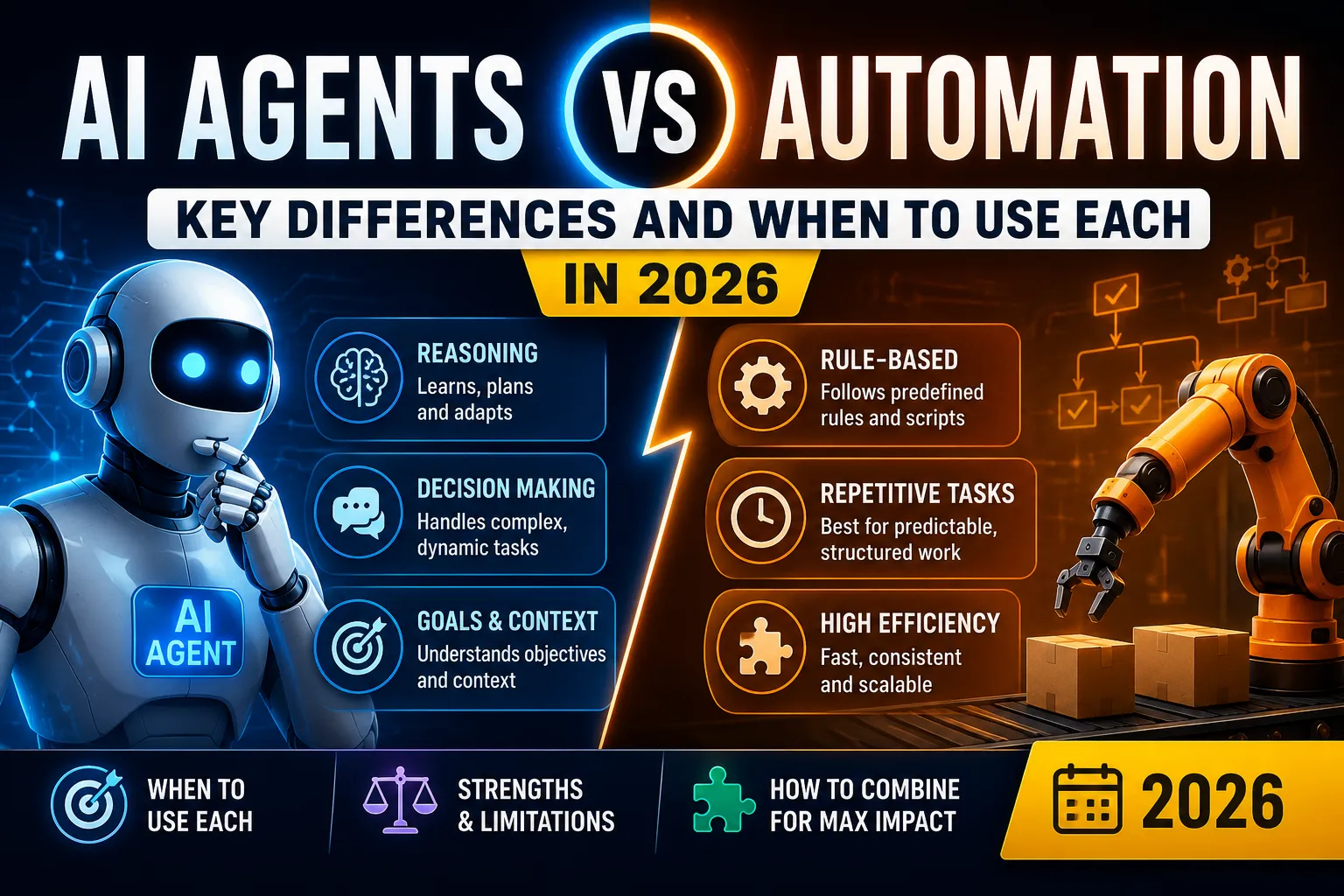
AI Automation Trends 2026: What's Coming Next
The complete guide to AI automation trends in 2026. Discover what's coming next in AI agents, autonomous workflows, hyper-personalization, no-code AI, predictive analytics, and generative AI.

AI Automation Trends 2026: What's Coming Next
AI automation is evolving rapidly. What was cutting-edge in 2025 is mainstream in 2026. And what's coming next will transform business operations even further.
This guide covers the most important AI automation trends for 2026 and beyond.
Key Takeaways
- AI agents are becoming autonomous – They handle entire workflows with minimal human intervention.
- Hyper-personalization is the next frontier – AI creates unique experiences for each customer.
- No-code AI is mainstream – Anyone can build AI automations without coding.
- Predictive AI enables proactive decisions – AI predicts issues before they happen.
- Generative AI extends automation – AI creates content, code, and designs.
- AI governance is essential – Regulations and ethics are becoming critical.
Who Is This Guide For?
This guide is for:
- Business owners and founders
- Operations managers
- IT leaders and developers
- Strategy and planning teams
- Anyone preparing for the future of AI automation
Trend 1: AI Agents Go Autonomous
What's Happening
AI agents are moving beyond simple task automation to autonomous workflow management. They can now:
- Plan – Define sequences of actions
- Execute – Perform tasks independently
- Adapt – Adjust to new situations
- Learn – Improve from feedback
- Collaborate – Work with other agents
Why It Matters
Autonomous AI agents handle entire business processes from start to finish. They don't just automate tasks—they manage workflows.
Examples
- Customer support agents: Handle entire support conversations from initial contact to resolution
- Sales agents: Manage the entire sales cycle from prospecting to closing
- Operations agents: Monitor supply chains and proactively address issues
- Marketing agents: Plan and execute multi-channel campaigns
What's Coming Next
- Multi-agent collaboration: Teams of specialized agents working together
- Agent-to-agent communication: Agents sharing information and coordinating actions
- Human-agent teams: Better collaboration between humans and AI agents
- Agent orchestration: Systems that manage and coordinate multiple agents
How to Prepare
- Identify processes that are complex and multi-step
- Start piloting AI agents in one area
- Build agent-friendly workflows
- Invest in agent orchestration capabilities
For a detailed comparison, read AI Agents vs Automation: Key Differences.
Trend 2: Hyper-Personalization at Scale
What's Happening
AI is moving from basic personalization to hyper-personalization. It now creates unique experiences for each individual.
Levels of Personalization
Why It Matters
Customers expect personalized experiences. AI can deliver at scale what humans can't.
Examples
- Marketing: Unique email content for each subscriber
- E-commerce: Product recommendations based on browsing and purchase history
- Customer support: Personalized responses based on customer history
- Content: Unique content for each user based on preferences
What's Coming Next
- Real-time personalization: Personalization based on current context
- Predictive personalization: Anticipating needs before they arise
- Multimodal personalization: Personalizing across text, voice, and visual interfaces
- Privacy-preserving personalization: Balancing personalization with data privacy
How to Prepare
- Collect and organize customer data
- Implement real-time data processing
- Use AI for personalization at scale
- Ensure privacy compliance
Trend 3: No-Code AI Becomes Mainstream
What's Happening
No-code AI platforms are making automation accessible to everyone. You no longer need to be a developer to build AI automations.
Why It Matters
No-code AI democratizes automation. Business users can build automations without waiting for developers.
Examples
- Zapier: Simple workflows with AI steps
- Make: Visual complex workflows with AI
- n8n: Open-source automation with AI capabilities
- Power Automate: AI automation in Microsoft ecosystem
What's Coming Next
- AI-assisted building: AI helps you build automations
- Templates and patterns: Pre-built automations for common use cases
- Integrated AI: AI capabilities built into every step
- Natural language building: Describe what you want in plain language
How to Prepare
- Identify workflows that can be automated
- Start with no-code platforms
- Train team members on no-code automation
- Build a library of reusable automations
For tool recommendations, read Best No-Code AI Automation Platforms.
Trend 4: Predictive AI Enables Proactive Decisions
What's Happening
AI is moving from reactive to proactive. It predicts issues before they happen and recommends actions.
Why It Matters
Reactive AI responds to events. Proactive AI prevents problems.
Examples
- Predictive maintenance: Equipment failure prediction
- Churn prediction: Identifying customers likely to leave
- Sales forecasting: Accurate revenue predictions
- Fraud detection: Catching fraud in real-time
- Demand forecasting: Predicting customer demand
What's Coming Next
- Prescriptive AI: AI that recommends specific actions
- Autonomous prediction: Systems that act on predictions without human intervention
- Predictive personalization: Anticipating customer needs
- Real-time prediction: Predictions based on current data
How to Prepare
- Identify decisions that can be predicted
- Collect and organize historical data
- Implement predictive AI models
- Build workflows based on predictions
Trend 5: Generative AI Extends Automation
What's Happening
Generative AI (text, image, code, video generation) is being integrated into automation workflows.
Why It Matters
Generative AI extends automation beyond repetitive tasks to creative and strategic work.
Examples
- Content creation: AI-generated blog posts, social media, emails
- Code generation: AI-written code
- Design: AI-generated images and designs
- Video: AI-generated video content
- Voice: AI-generated voice and audio
What's Coming Next
- Multimodal generation: Text, image, and video in a single workflow
- Interactive generation: AI collaborates with humans on creative work
- Personalized generation: AI creates unique content for each user
- Real-time generation: Content generated on-demand
How to Prepare
- Identify creative tasks that can be automated
- Train AI on your brand voice and style
- Implement generative AI in workflows
- Maintain human oversight for quality
Trend 6: AI Governance and Ethics
What's Happening
Governments and businesses are implementing AI governance frameworks. Regulations, ethics, and transparency are becoming critical.
Key Regulations
Why It Matters
Non-compliance means significant fines, legal liability, and reputational damage.
What's Coming Next
- Algorithmic accountability: Explaining AI decisions
- AI risk management: Assessing and mitigating AI risks
- Auditable AI: Auditing AI systems
- Human-in-the-loop requirements: Mandatory human oversight for critical decisions
How to Prepare
- Review compliance requirements
- Implement AI governance framework
- Document AI decision-making
- Conduct regular AI audits
- Provide transparency to customers
For security guidance, read AI Automation Security Risks: What You Need to Know.
Trend 7: Edge AI and Real-Time Processing
What's Happening
AI is moving to the edge. Real-time processing is becoming standard for AI automation.
Why It Matters
Cloud AI has latency. Edge AI enables real-time decisions.
Examples
- Industrial IoT: Real-time equipment monitoring
- Retail: Real-time inventory and pricing
- Healthcare: Real-time patient monitoring
- Logistics: Real-time route optimization
What's Coming Next
- Edge-cloud hybrid: Combining edge and cloud AI
- Lightweight AI models: AI that runs on edge devices
- Real-time training: Models updating continuously
- Low-latency automation: Automation in milliseconds
How to Prepare
- Identify latency-sensitive use cases
- Implement edge AI capabilities
- Combine edge and cloud AI
- Build for real-time processing
Trend 8: AI-Powered Workforce
What's Happening
AI is becoming a digital workforce. Humans and AI are working together as teams.
Why It Matters
AI does repetitive tasks. Humans do strategic, creative, and relationship work.
Examples
- Digital assistants: AI for every employee
- AI agents: AI that works alongside humans
- AI-powered tools: AI integrated into every tool
What's Coming Next
- AI co-pilots: AI assisting in every task
- AI teammates: AI as a full team member
- AI-managed workflows: AI managing human work
- AI leadership: AI assisting in decision-making
How to Prepare
- Identify tasks for humans vs. AI
- Train employees on AI collaboration
- Implement AI-assisted tools
- Build human-AI workflows
Trend 9: Conversational AI and Natural Language Interfaces
What's Happening
Conversational AI (text, voice) is becoming the primary interface for automation.
Why It Matters
Natural language interfaces make automation accessible to everyone.
Examples
- Voice-activated automation: "Hey AI, create a lead qualification workflow"
- Conversational AI: Chat-based automation
- Natural language queries: "Show me all customers who haven't purchased in 6 months"
What's Coming Next
- Multimodal conversation: Text, voice, and visual
- Contextual conversation: AI remembers context
- Proactive conversation: AI initiates conversations
- Emotional AI: AI understands and responds to emotions
How to Prepare
- Implement conversational interfaces
- Train AI on natural language
- Build conversation flows
- Integrate with existing systems
Trend 10: AI Marketplace and Ecosystem
What's Happening
AI automation is becoming an ecosystem of pre-built agents and workflows.
Why It Matters
Pre-built solutions speed up implementation and reduce costs.
Examples
- Agent marketplace: Buy and sell AI agents
- Workflow templates: Pre-built automations
- AI services: Specialized AI capabilities
What's Coming Next
- Agent-to-agent marketplace: Agents buying services from other agents
- Customization marketplace: Tailored solutions
- AI service providers: Specialized AI services
- Enterprise AI marketplaces: Enterprise-wide solutions
How to Prepare
- Evaluate pre-built solutions
- Build internal AI capabilities
- Participate in AI ecosystem
- Develop reusable AI components
How to Prepare for These Trends
1. Assess Your Current State
- What AI automation do you have?
- What processes are candidates for automation?
- What skills do you have?
2. Build a Roadmap
- Prioritize trends that matter
- Sequence implementation
- Build capabilities gradually
3. Invest in Skills and Infrastructure
- Train your team
- Implement appropriate tools
- Build automation capabilities
4. Start Small, Learn Fast
- Pilot one trend
- Measure results
- Iterate and scale
5. Stay Informed
- Follow AI automation trends
- Attend conferences
- Read industry publications
- Network with peers
Timeline: When Will These Trends Happen?
Comparison Table: Trends by Impact and Timeline
Conclusion
AI automation is evolving rapidly. These trends will transform how businesses operate.
Key trends:
- AI agents are becoming autonomous
- Hyper-personalization at scale
- No-code AI is mainstream
- Predictive AI enables proactive decisions
- Generative AI extends automation
- AI governance is essential
- Edge AI and real-time processing
- AI-powered workforce collaboration
- Conversational AI as primary interface
- AI marketplace and ecosystem
Your next steps:
- Assess your current AI capabilities
- Prioritize trends that matter for your business
- Build a roadmap
- Start with one trend
- Measure and iterate
FAQ
What are the biggest AI automation trends in 2026?
The biggest trends include AI agents that handle entire workflows autonomously, hyper-personalization at scale, no-code AI becoming mainstream, predictive AI for proactive decisions, generative AI for creative work, and AI governance regulations.
How will AI agents change automation in 2026?
AI agents will move beyond simple task automation to autonomous workflow management. They will plan, execute, and adapt to new situations with minimal human intervention. This will enable end-to-end automation of complex business processes.
What is hyper-personalization in AI automation?
Hyper-personalization uses AI to create unique experiences for each customer. It analyzes behavior, preferences, and context to deliver personalized content, recommendations, and interactions. It's the next evolution of personalization at scale.
Is no-code AI automation becoming mainstream?
Yes. No-code AI platforms like Zapier, Make, and n8n are making AI automation accessible to non-technical users. This trend is accelerating as these platforms add more AI capabilities and simpler interfaces.
What is the impact of generative AI on automation?
Generative AI is transforming automation by enabling AI to create content, code, and designs. This extends automation beyond repetitive tasks to creative and strategic work. Marketing, content creation, and software development are being transformed.
How should businesses prepare for AI automation trends?
Prepare by assessing current capabilities, building a roadmap, investing in skills and infrastructure, starting with small pilots, and staying informed about new developments. Prioritize trends that matter most for your business.
Related Guides
- AI Automation Guide for Businesses in 2026
- AI Agents vs Automation: Key Differences
- Common AI Automation Mistakes to Avoid
- AI Automation Security Risks: What You Need to Know
Read Next
- How to Build AI Workflows: A Step-by-Step Guide
- Best AI Automation Tools for Small Businesses
- AI Automation Examples: Real-World Use Cases
Related articles
AI Automation vs Traditional Automation: Key Differences in 2026
Building an incident dashboard for rapid triage
Choosing the right tools for Conversion Rate Optimization
Cost-aware telemetry: retention & cardinality strategies
Frequently asked questions
What are the biggest AI automation trends in 2026?
The biggest trends include AI agents that handle entire workflows autonomously, hyper-personalization at scale, no-code AI becoming mainstream, predictive AI for proactive decisions, generative AI for creative work, and AI governance regulations.
How will AI agents change automation in 2026?
AI agents will move beyond simple task automation to autonomous workflow management. They will plan, execute, and adapt to new situations with minimal human intervention. This will enable end-to-end automation of complex business processes.
What is hyper-personalization in AI automation?
Hyper-personalization uses AI to create unique experiences for each customer. It analyzes behavior, preferences, and context to deliver personalized content, recommendations, and interactions. It's the next evolution of personalization at scale.
Is no-code AI automation becoming mainstream?
Yes. No-code AI platforms like Zapier, Make, and n8n are making AI automation accessible to non-technical users. This trend is accelerating as these platforms add more AI capabilities and simpler interfaces.
What is the impact of generative AI on automation?
Generative AI is transforming automation by enabling AI to create content, code, and designs. This extends automation beyond repetitive tasks to creative and strategic work. Marketing, content creation, and software development are being transformed.

Author
saad-elfallah
Saad writes about AI systems, software engineering, cybersecurity, and the tools shaping modern product teams.